Frequently Asked Questions (FAQs)

In these FAQs the term "General Penalty" means a 2-stoke penalty in strokeplay and loss of hole in matchplay.

While useful, these FAQs are not a substitute for studying the Rules of Golf, which are available on the R & A website at: https://www.randa.org/rog/the-rules-of-golf and also as an app for Android, iPhone and iPad on the Play/Apple stores.

The Local Rules for Minthis Golf Club can be found on the back of the scorecard, in the Competitions Folder and on the website here: Local_Rules.pdf

Any Temporary Local Rules (such as relief from slits in the fairway) are posted on the notice board in the caddy-master's office.

The Conditions of Entry for Minthis Competitions can be found in the Competitions Folder and on the website here: Conditions_of_Entry_for_Competitions.pdf

To open/close the answer just click on the FAQ number. To open/close all of the answers just click the switch below

When is a ball out of bounds (OOB)?

  • Rule 18.2a(2)
  • A ball at rest is out of bounds only when all of it is outside the boundary edge of the course. A ball is in bounds when any part of the ball:
    • Lies on or touches the ground or anything else (such as any natural or artificial object) inside the boundary edge, or
    • Is above the boundary edge or any other part of the course.
A ball is OOB only when ALL of the ball is over the course side of the OOB line, or the line joining the course side of the adjacent OOB stakes. Even if only a tiny sliver of ball is on the course side of the line, the ball is in-bounds and may be played. If necessary you can stand OOB to play a ball that is in-bounds.

When is a ball in a Penalty Area?

  • Rule 17.1a
  • A ball is in a penalty area when any part of the ball:
    • Lies on or touches the ground or anything else (such as any natural or artificial object) inside the edge of the penalty area, or
    • Is above the edge or any other part of the penalty area.
  • Local Rule 2. - Penalty Areas (Rule 17)
  • 2a) Penalty areas are defined by RED or YELLOW stakes or lines. The extents of concrete penalty areas and that of the island green are defined by the walls or concrete. The extent of all other penalty areas are defined by the line of stakes.
A ball is in a penalty area when ANY PART of that ball is over or touching the penalty area line. So even if the ball is just resting against a penalty area stake and has not gone over the line it is still in the penalty area. You may move penalty area stakes, even if your ball is in the penalty area, but please replace them correctly afterwards.

However the extents of concrete penalty areas and that of the island green are the walls/concrete, not the stakes, so if the ball is touching one of these stakes it is not in the penalty area, unless it is also touching the wall.

Am I allowed to hold the flagstick while tapping in a short put?

  • Rule 4.3 - Allowed and Prohibited Uses of Equipment
  • Rule 13.2b - Removing Flagstick from Hole
Yes you can hold the flagstick, provided you don’t lean on it or let the ball hit it if you are holding it in the cup.

You may hold the flagstick while you putt out without penalty provided that:

  • you do not rest the flagstick on the ground as you hold it, since you may be deemed to be using it to steady yourself, which is a breach of Rule 4.3, the penalty for which is the General Penalty for the first occurrence and disqualification for further breaches of this rule! Hold it above the ground instead.
  • if you hold the flagstick in the cup you must remove it from the hole before the ball can hit it, otherwise this would be a breach of Rule 13.2 the penalty for which is the General Penalty.

Having hit a shot I accidentally hit a staked tree with my club on the follow-through, what is the ruling?

  • Local Rule 5e - Immovable Obstructions
  • 5e) Staked trees and trees with stakes adjacent. N.B. Relief must be taken.
You incur the General Penalty

Since you hit the tree you obviously should have taken relief, by not doing so you are in breach of the above Local rule.

What is the procedure for taking a "free" drop?

  • Rule 16 - Relief from Abnormal Course Conditions (Including Immovable Obstructions), Dangerous Animal Condition, Embedded Ball
  • Nearest Point of Relief (taken from the Rules of Golf)
    The "nearest point of relief" is the reference point for taking relief without penalty from interference by an immovable obstruction, an abnormal ground condition or a wrong putting green. It is the estimated point where the ball would lie that is:
    • Nearest to the ball's original spot, but not nearer the hole than that spot,
    • In the required area of the course, and
    • Where there is no interference (under the Rule being used) from the condition from which relief is being taken for the stroke the player would have made from the original spot if the condition were not there. 
Unless specified otherwise within the rules e.g. for GUR and staked trees, you are not forced to take free relief, you are allowed play the ball as it lies if that is what you would like to do.

The following diagram (courtesy of the R&A) illustrates the term "nearest point of relief" in the case of a right-handed player. It shows two ball positions (B1 on a road/GUR etc and B2 next to a road/GUR etc) and their respective nearest point of relief (P1 and P2)as an example. Instead of a road/GUR it could just as well be a staked tree or a sprinkler head or any immovable obstruction.
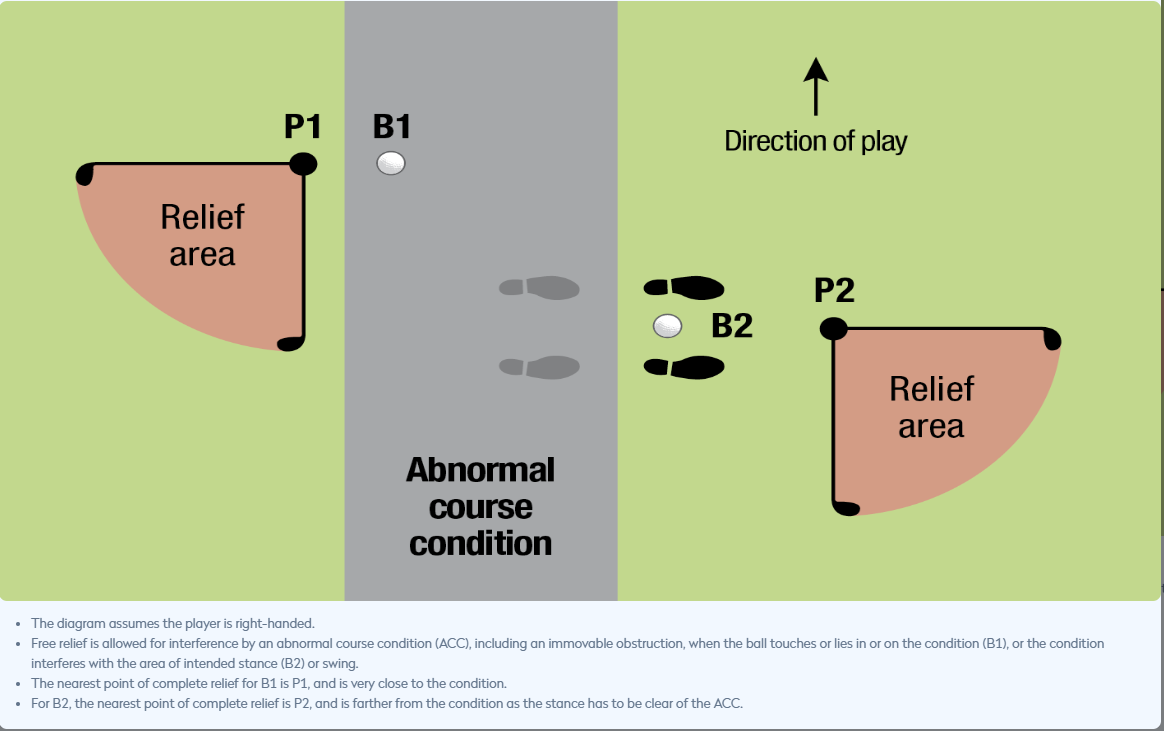
Nearest Point of Relief

The simple answer is that you drop within one club-length of the nearest point of relief (as shown above) and the ball must come to rest in that area. The ball is dropped from knee height.

There are conditions attached to dropping the ball depending upon where the original ball lay. e.g. the ball must be re-dropped if it:

  1. rolls into and comes to rest in a penalty area;
  2. rolls out of and comes to rest outside a penalty area;
  3. rolls onto and comes to rest on a putting green;
  4. rolls and comes to rest out of bounds;
  5. rolls and comes to rest in a position where there is interference by the condition from which relief was taken;
  6. rolls and comes to rest further than one club-length from the nearest point of relief;
  7. rolls and comes to rest closer to the hole than the nearest point of relief.

Note that if you are taking a "free drop" in a bunker, the dropped ball must remain in the bunker. If there is nowhere in the bunker to drop (e.g. it is completely full of water) then you could go for maximum relief e.g. by droping the ball in shallower water in the bunker, you may also drop outside the bunker, but at the cost of a penalty stroke.

If your original ball was on the course but not on the putting green of the hole being played you cannot drop the ball on the putting green.

One last important point - you cannot claim a "free drop" from interference by an immovable obstruction if that interference would occur only through use of a clearly unreasonable stroke, or an unnecessarily abnormal stance, swing or direction of play.

If my ball is on a cart path am I allowed to drop it on the fairway but stand on the cart path to play it?

  • Rule 16 - Relief from Abnormal Course Conditions (Including Immovable Obstructions), Dangerous Animal Condition, Embedded Ball
  • Rule 16.1b Relief for Ball in General Area ...There must be complete relief from all interference by the abnormal course condition....
No. If you take "free" relief you must take complete relief from the path. Of course you don't have to take relief from the path, you can play it as it lies, but if you do take relief, it has to be complete relief.

See the FAQ "What is the procedure for taking a "free" drop?"

If my ball is not in a no-play zone, but to play it I would have to stand in the no-play zone. What are my options?

  • 16.1f(2) - Relief When No Play Zone Interferes with Stance or Swing for Ball Anywhere on Course Except Penalty Area
  • If a player’s ball is outside a no play zone and is in the general area, in a bunker or on the putting green, and a no play zone (whether in an abnormal course condition or in a penalty area) interferes with the player’s area of intended stance or area of intended swing, the player must either:
    1. Take relief if allowed under Rule 16.1b, c or d, depending on whether the ball is in the general area, in a bunker or on the putting green, or
    2. Take unplayable ball relief under Rule 19.
You are not allowed to enter a no-play zone, so basically, you can:
  • take a "free" drop, or
  • declare your ball unplayable, which would incur a 1-stroke penalty, or
  • take "stroke and distance relief", which would incur a 1-stroke penalty.

See the FAQ "What is the procedure for taking a "free" drop?"

Do I get free relief if my ball is touching the wall of a drainage ditch e.g. in front of the 17th green?

  • Local Rule 2 - Penalty Areas
  • Penalty areas are defined by red or yellow stakes or lines. The extents of concrete penalty areas and that of the island green are defined by the walls/concrete, the extent of all other penalty areas are defined by the line of stakes.
  • Definition - [Immovable] Obstructions
  • Any artificial object except for integral objects and boundary objects.
    Examples of obstructions:
    Stakes, walls, railings and fences (but not when they are boundary objects that define or show the boundary edge of the course),
No, you do not get relief if your ball is touching the wall. The wall is part of the penalty area and since the ball is touching the wall it is by definition in the penalty area and as such you do not get relief from any immovable obstructions.

If however your ball was not touching the wall and not in the penalty area and the wall would physically interfere with your intended stance or your swing then you can obtain relief without penalty. You should drop the ball following the procedure described in these FAQs.

Also, note the wording of Local Rule 2. The stakes for this type of penalty area are not part of the penalty area itself, they are only there to tell you whether the penalty area is a regular penalty area (yellow) or a lateral penalty area (red). The side of the wall is the boundary. So if your ball comes to rest behind the stakes but is not touching the wall or in the ditch then it is not in the penalty area and so it is highly likely that you will be able to claim relief without penalty.

One other point about the stakes. The stakes are movable obstructions (Local Rule 6) so they may be removed to play a shot from inside or outside the penalty area, e.g. if your ball is on top of the wall and you elect to play it from there.

If I drive off the 3rd tee and my ball lands on the 4th green can I play it from there?

  • 13.1f - Relief Must Be Taken from Wrong Green
No, if your ball is on the wrong green, or if the green interferes with your stance or swing you must take a "free" drop. If you do in fact play the ball from the green you will incur the General Penalty, as well as the ire of the greenkeeping staff!

I played from a wrong place, what do I do?

  • Rule 14.7 - Playing From a Wrong Place
It depends on whether you gained a significant advantage in playing from the wrong place.
  1. Say you accidentally hit your ball when making a practice swing on the 10th fairway and it only moved a metre or two then you hit the ball from this wrong place. The metre or so advantage you gained by doing this is unlikely to have given you a significant advantage, so you must continue with the ball as you would normally, having incurred the general penalty. You no longer have the option of playing a ball from the right place.
  2. Say you are in front of the bunker on the 8th hole and while practising your chip over the bunker you accidentally hit the ball such that it moves a metre to the left and in that position you no longer have to chip over the bunker but can putt the ball instead, so you putt it next to or into the hole. You have obviously just played from a wrong place so incur the genaral penalty and by doing this have gained a significant advantage. If you do not correct this mistake by playing from the point you should have chipped from before teeing off on the next hole you will be disqualified.
  3. Say you hit your ball on the 10th fairway 120 metres forward but into the no-play zone on the left-hand side of the fairway. Instead of going back to where you hit it (stroke and distance) you drop the ball next to where it entered the no-play zone and play it from there. You have obviously just played from a wrong place so you incur the General Penalty penalty and by doing this have gained a significant advantage (120 metres). If you do not correct this mistake before teeing off on the next hole you will be disqualified.

I took a practice swing and accidentally hit my ball, what is the ruling?

  • 9.4 - Ball Lifted or Moved by Player
It depends on whereabouts you were when you hit the ball:
  1. In the teeing area – No penalty, just tee up the ball again and hit it.
  2. On the green – No penalty just place the ball where you accidentally hit it from and play from there.
  3. Elsewhere – You incur a 1-stroke penalty if you replace the ball where it was before you accidentally hit it. If you do not replace the ball and hit it from where it moved to you have played from a wrong place and usually the 1-stroke penalty becomes the General Penalty instead. But see the answer the the FAQ "I played from a wrong place, what do I do?" for a more detailed explanation.

In greensomes what do you do if both players on a team drive their ball out of bounds?

  • Rule 22.3 - Side Must Alternate in Taking Shots
  • In a threesome or a foursome, during any stipulated round the partners must play alternately from the teeing grounds and alternately during the play of each hole. Penalty strokes do not affect the order of play.
You nominate one of the balls as the one you choose and if it is Player-A's ball then Player-B plays the next shot and vice-versa.

If both players were teeing off and it is a mixed greensomes and Player-A is a man, then his lady partner must play the next shot from the men's tee from which he played (she may tee up the ball), not from the ladies’ tee and vice versa.

The Rules of Golf do not mention “greensomes” specifically, but greensomes is a special case of foursomes once both players have teed-off and nominated their chosen ball.

In foursomes what do you do if a player plays out of turn?

  • Rule 22.3 - Side Must Alternate in Taking Shots
  • In a threesome or a foursome, during any stipulated round the partners must play alternately from the teeing grounds and alternately during the play of each hole. Penalty strokes do not affect the order of play.
The side incurs the General Penalty.

In strokeplay the side must correct the mistake before teeing off at the next hole else their team would be disqualified.

In foursomes what do you do if player does an "air shot"?

  • Rule 22.3 - Side Must Alternate in Taking Shots.
  • In a threesome or a foursome, during any stipulated round the partners must play alternately from the teeing grounds and alternately during the play of each hole. Penalty strokes do not affect the order of play.
If Player-A did the "air-shot" then Player-B must play the next stroke and vice-versa.

An "air-shot" is a stroke, since the player intended to strike the ball, so the rule of alternate strokes means that the player's partner must play the next shot.

However, if Player-A deliberately did an "air shot" (e.g. to give his team some sort of advantage - say when playing over water), then he has not made a stroke and if Player-B takes the next shot he has played out of turn and would incur the General Penalty. In strokeplay, if before teeing off on the next hole Player-A did not correct this by playing the ball from where it was when he did the deliberate air-shot their team would be disqualified.

If my ball lands in a bunker that is GUR do I have to drop the ball back in front of the bunker in line with the flagstick?

  • Rule 16 - Relief from Abnormal Course Conditions (Including Immovable Obstructions), Dangerous Animal Condition, Embedded Ball
No. You are taking relief from an abnormal course condition, not taking a drop from an unplayable lie or from a penalty area.

There is nothing special about a bunker that has been designated "ground under repair" as opposed to any other abnormal ground condition.

Quite a few people mistakenly believe that the point at which the ball entered the bunker needs to be taken into consideration. It doesn't, unless you can't find the ball in which case that is the point you use to determine the nearest point of relief. You may even find that the nearest point of relief is at the side of the bunker and that this takes the bunker "out-of-play"

So just determine the nearest point of relief and follow the procedure described in the FAQ "What is the procedure for taking a 'free' drop".

If I drop a ball in a drop zone and it rolls outside the drop zone do I have to re-drop it?

  • R&A Model Local Rule E1 - Dropping Zones
  • The following points apply when dropping a ball in a dropping zone:
    • The player does not have to stand in the dropping zone when dropping the ball.
    • When a player is using a dropping zone, the relief area is defined by that dropping zone and the ball must be dropped in and come to rest in the dropping zone (see Rule 14.3).
    • If the dropping zone is defined by a line on the ground, the line is inside the dropping zone.
Yes you have to redrop the ball if it comes to rest outside the dropping zone.

What am I allowed to do if my ball comes to rest in the penalty area surrounding the island green?

  • Local Rule 2 - Penalty Areas
  • 2b) If a ball comes to rest in the penalty area on the 15th hole (island green) the player has three options.
    • they may play a ball from where the previous stroke was made (stroke-and-distance), or
    • they may drop a ball in line with the hole and where it crossed the boundary of the penalty area or
    • they may play from the designated drop zone.
    It is not permitted to drop a ball on the green or its immediate surrounds under Rule 17.
What the local rule means is that you have three options (and only three options), each of which incur a penalty of one stroke.

You may:

  1. drop a ball as near as possible to the spot from where you played the ball that ended up in the water. This is commonly known as “Stroke and Distance”, or
  2. drop the ball in the dropping zone (see also FAQ 2), or
  3. go as far back as you wish on a line keeping the point at which the ball last crossed the boundary of the penalty area in line with the hole.

You must not enter the penalty area and play the ball as it lies otherwise you will have played from a wrong place.

You must not the drop a ball on the green or its immediate surrounds otherwise you will have played from a wrong place.

If it was your tee-shot that ended up in the penalty area and you elect to use the "stroke and distance" option you may play the new ball from anywhere within the teeing ground and may tee-up the ball. Note that the "teeing ground" is the rectangular area 2 club-lengths in depth, the front and sides of which are defined by the outside limits of the two tee-markers.

Please be aware that the drainage ditch on this hole is not part of the penalty area that surrounds the green and as such the "normal" rules for dropping the ball apply. If a ball lands in here, the dropping zone is not an option and playing from there would mean you have played from a wrong place.

Someone I was playing with removed an out-of-bounds stake. When I told him that wasn't allowed he replaced it before playing his shot, what is the ruling?

  • Rule 8.1 - Player’s Actions That Improve Conditions Affecting the Stroke
No penalty, provided that he replaced the stake exactly as it was before he removed it.

Objects defining out of bounds are not movable obstructions they are "boundary objects", and so may not be moved.

The player was in breach of Rule 8.1a(1) the moment he moved the post. However, by replacing the stake before playing his shot he avoided this penalty, but only if he put the stake back as it was before he removed it (e.g. if it was leaning at an angle of 45° before he removed it, he should ensure it was leaning at the same angle and in the same direction when he replaced it), otherwise he incurs the General Penalty.

Can you remove sand, loose soil, leaves etc. from a green even if your ball is not on the green?

  • Rule 13.1c - Improvements Allowed on Putting Green
  • During a round and while play is stopped under Rule 5.7a, a player may take these two actions on the putting green, no matter whether the ball is on or off the putting green:
    1. Removal of Sand and Loose Soil. Sand and loose soil on the putting green may be removed without penalty.
    2. Repair of Damage. A player may repair damage on the putting green without penalty by taking reasonable actions to restore the putting green as nearly as possible to its original condition...
Yes. Whether or not your ball is on the green is immaterial

Can you remove sand from the apron of a green?

  • Definition - Loose Impediment
  • ... Sand and Loose Soil are not loose impediments (this does not include a mound built by a worm, insect or similar animal) ...
No.

However, when you have completed a hole if you see clumps of sand that have obviously been ejected by a bunker shot you may sweep these back into the bunker in the interest of caring for the course.

Can I use a caddie in Minthis club competitions?

  • Conditions of Entry for Competitions - Caddies
  • Unless specified otherwise for individual competitions, caddies are permitted in any of the competitions, however they can only help ball spot, find lost balls, score, rake bunkers, provide other care for the course, help with clarification of Rules and talk to the players. They must not give advice. If a caddie does give advice his player will be penalised the General Penalty for each offense.
Normally yes, unless specifically prevented from doing so in the rules of entry.

However, please note the restrictions above on what caddies are permitted to do.

In fourball matchplay can I refuse to accept a conceded putt and play my ball to help my partner determine how to play his putt?

  • 3.2b(2) - How Concessions Are Made.
  • ...A concession is final and cannot be declined or withdrawn...
  • 23.6 - Side’s Order of Play
  • Continuing Play of Hole After Stroke Conceded in Match Play:
    • A player must not continue play of a hole after the player’s next stroke has been conceded if this would help their partner.
    • If the player does so, their score for the hole stands without penalty, but the partner's score for the hole cannot count for the side.
No, you cannot decline a concession, nor can the other team withdraw it.

If you continue to play your ball to help your partner (e.g. in determining the slope or speed of the green) then your score will be the one that counts for the team, not your partner's. So if you are conceded a putt just thank your opponents and pick up your ball.

e.g. Suppose your partner and your two opponents are on the island green in 1 shot while you lost 2 balls in the lake and were on in 5. The other team concedes your putt for a 6, but you play your ball to help your partner and take a 7. Then the opposing team has only to score better than a 7 to win the hole, even if your partner sinks his putt for a 2 and they double-putt for a 3.

In matchplay if I mistakenly think my putt has been conceded and pick my ball up do I lose the hole?

  • 3.2b(2) - How Concessions Are Made. A concession is made only when clearly communicated:
    1. ' This can be done either verbally or by an action that clearly shows the player's intent to concede the stroke, the hole or the match (such as making a gesture).
    2. If the opponent lifts their ball in breach of a Rule because of a reasonable misunderstanding that the player's statement or action was a concession of the next stroke or the hole or match, there is no penalty and the ball must be replaced on its original spot (which if not known must be estimated) (see Rule 14.2). A concession is final and cannot be declined or withdrawn.
No you do not lose the hole if the misunderstanding was reasonable, you simply place the ball back where it was, or where you estimate it to have been and play without penalty.

Can you clarify what to do if my ball is in the no-play zone on the 10th hole?

  • 17.1e - Relief Must Be Taken from Interference by No Play Zone in Penalty Area
  • When Ball Is in No Play Zone in Penalty Area. The player must take penalty relief under Rule 17.1d or 17.2.
You are not allowed to enter a no-play zone, so basically you must take relief with a 1-stroke penalty. What type of relief is available depends mainly on where your ball crossed the no-play zone penalty area boundary. Don't forget that even if your ball is only slightly past the stakes, or is even just resting against a stake it is deemed to be in the no-play zone, so don't attempt to play it.

The no-play zone on hole 10 has yellow stakes with green tops. This means that besides "stroke-and-distance relief" and use of the drop-zone you can also take "back-on-the-line" relief, where you draw an imaginary line from the hole to the point of entry of the ball and drop back on that line. You cannot take "lateral relief", where you drop anywhere within 2 club-lengths of the point of entry as that would be designed by red stakes with green tops.

The problem with "back-on-the-line" relief for the left-hand side of the fairway and at the front is that it is impossible to go back on the imaginary line without entering the no-play zone, which is forbidden. In this case you are limited to "stroke-and-distance" relief, or using the drop-zone.

This problen also occurs for some of the boundary of the no-play zone on the right-hand side of the fairway. However, there are parts of the boundary on that side where it is possible to use "back-on-the-line relief" and drop the ball in the rough or on the fairway at the cost of a 1-stroke penalty. Please note that if by dropping the ball on the imaginary line you would then have to stand in the no-play zone to play it (for example if you play golf left-handed) you get free relief from that - see the FAQ "If my ball is not in a no-play zone, but to play it I would have to stand in the no-play zone. What are my options?.

My ball is in a footprint in a bunker just in front of another player's ball, what do we do?

  • 14 - Procedures for Ball: Marking, Lifting and Cleaning; Replacing on Spot; Dropping in Relief Area; Playing from Wrong Place
  • 14.2d - Where to Replace Ball When Original Lie Altered
  • If the lie of a lifted or moved ball that must be replaced is altered, the player must replace the ball in this way:

    1) Ball in Sand. When the ball was in sand, whether in a bunker or anywhere else on the course:

    • In replacing the ball on its original spot (which if not known must be estimated) (see Rule 14.2c), the player must re-create the original lie as much as possible.
    • In re-creating the lie, the player may leave a small part of the ball visible if the ball had been covered by sand.
    If the player plays from the right place but fails to re-create the lie in breach of this Rule, the player gets the general penalty.

The other player should ask you to mark the ball. You should then mark and lift it, allow the other player to play, recreate the lie your ball was in (if this was destroyed) then play your shot.

The other player would normally ask you to mark your ball, if not, you could offer to do this, but it is not your decision whether your ball should be marked or not. If you are not asked to mark and lift the ball you must not do so, as you would incur the General Penalty if you did. If your ball was not marked and lifted and the other player accidentally hit it when making his shot there is no penalty as it would be deemed to have been moved by an "outside agency" and your ball should be placed back where it was.

If, after the other player has played his shot, the original lie of your ball is destroyed or changed, you must recreate the lie as close as possible to how it was before. This might involve raking that part of the bunker, making a footprint similar to the one that was there before and pressing your ball into the footprint e.g. if it was half buried before. Then you may play your shot.

If you do not recreate the lie as described above you will be penalised the General Penalty.

If my ball is on the green and I put a marker behind it then step away to judge the line to take and the wind moves the ball several inches should I replace it where the marker is?

  • 9.3 - Ball Moved by Natural Forces
  • If natural forces (such as wind or water) cause a player’s ball at rest to move:
    • There is no penalty, and
    • The ball must be played from its new spot.

    Exception 1 – Ball on Putting Green Must Be Replaced If It Moves After Having Already Been Lifted and Replaced (see Rule 13.1d): If the player’s ball on the putting green moves after the player had already lifted and replaced the ball on the spot from which it moved:

    • The ball must be replaced on its original spot (which if not known must be estimated) (see Rule 14.2).
    • This is true no matter what caused it to move (including natural forces).

No. The ball must be played from the spot to which it rolled, not re-placed to where the marker is.

The reason for this is that putting a marker down is not enough to allow the ball to be re-placed. You have to:

  • put the marker down;
  • lift the ball (you may clean it if you wish);
  • re-place the ball.
Only after doing this can you replace the ball again if the wind (or other natural force) moves it, otherwise you incur the General Penalty.

Of course if the ball is on the green and is moved by a non-natural force, e.g. by the player or another player, it must be re-placed without penalty.

My ball rolled into a bunker and was stopped by a rake. When I removed the rake the ball moved. Is this a penalty?

  • 15.2a- Relief from Movable Obstruction
  • (1) Removal of Movable Obstruction. Without penalty, a player may remove a movable obstruction anywhere on or off the course and may do so in any way.

    If a player’s ball moves while they are removing a movable obstruction:

    • There is no penalty, and
    • The ball must be replaced on its original spot (which if not known must be estimated) (see Rule 14.2).

No. The rake is a movable obstruction, so you just re-place your ball where it was with no penalty.

However, had it been a twig rather than a rake that is a different matter. A twig is not a movable obstruction, it is a loose impediment. Had your ball moved when you removed the twig you would have incurred a 1-stroke penalty and you would have had to re-place your ball.

Note, if you caused your ball to move while removing a loose impediment on the green, or while searching for the ball you would not have incurred any penalty.

Can you clarify once and for all what the stakes with green tops are and what options do I have for relief?

  • Local Rule - No-Play Zones
  • A no-play zone is marked with BLUE/YELLOW/RED/WHITE stakes with GREEN tops and is a defined part of an abnormal course condition or a penalty area or out of bounds where play is not allowed and entry to this area is prohibited.
    • For a ball at rest in a no-play zone defined by BLUE stakes with GREEN tops, FREE relief MUST be taken under Rule 16.1f(1).
    • For a ball at rest in a no-play zone defined by YELLOW/RED stakes with GREEN tops, relief MUST be taken under Rule 17.1e.
    • A ball at rest in a no-play zone defined by WHITE stakes with GREEN tops is out of bounds.
    • For any no-play zone that interferes with a player's intended area of stance or swing, but where the ball is not in the no-play zone, relief must be taken under rule 16.1f(2).
If your ball is in a no-play zone:
  • you must take relief according to the color of the GREEN-topped stakes:
    ColourType of Relief
    BLUE "free relief" since your ball is in an abnormal course condition;
    YELLOW"1-stroke penalty relief" since your ball is in a yellow penalty area;
    RED "1-stroke penalty relief" since your ball is in a red penalty area;
    WHITE "stroke and distance relief" only, since your ball is out of bounds.
  • you must not enter the zone otherwise you incur the Gneral Penalty. If you can see your ball, try using a ball retriever to retrieve it. If you enter a no-play zone between holes then the General Penalty applies to the next hole, not the last;

If your ball is not in the no-play zone but in order to play it as it lies the no-play zone would interfere with your intended area of stance or swing you must take "free relief" no matter what the colour of the no-play zone's stakes are.
(There are other options for relief in this situation, like "stroke and distance relief", which is always available, but since these incur a 1-stroke penalty and you can take "free relief" you would be highly unlikely to choose one of these).

What does the term "Known or Virtually Certain" mean when trying to decide what happened to a ball?

  • Definition - Known or Virtually Certain
  • The standard for deciding what happened to a player’s ball – for example, whether the ball came to rest in a penalty area, whether it moved or what caused it to move.

    Known or virtually certain means more than just possible or probable. It means that either:

    • There is conclusive evidence that the event in question happened to the player's ball, such as when the player or other witnesses saw it happen, or
    • Although there is a very small degree of doubt, all reasonably available information shows that it is at least 95% likely that the event in question happened.

    "All reasonably available information" includes all information the player knows and all other information they can get with reasonable effort and without unreasonable delay.

    When searching for a ball, only information discovered within the three-minute search time is considered when determining whether knowledge or virtual certainty exists.

Take for example a ball hit towards a penalty area or an abnormal condition, this definition effectively means:
  • if someone, not necessarily in the group - it could be a greenkeeper or a player in another group, saw the ball land in the penalty area or abnormal ground condition it is known to be in it;
  • if there is really no way it could be anywhere else but in the penalty area or abnormal ground condition, it is virtually certain that it is in it;
  • otherwise it's a lost ball.

Example 1 On the 9th hole you hit a ball off the tee and see that it lands on the fairway but rolls towards the lake. When you get there you can't find the ball. It isn't on the fairway and since you know it hit the fairway past the rough at the start of the lake and you know that you cannot hit it beyond the end of the lake and that along the side of the lake penalty area there is no rough for the ball to hide in it is virtually certain that it is in the penalty area. So you may take a "penalty drop" where the ball is estimated to have crossed the extent of the penalty area.

Example 2 On the 8th hole you hit a ball from the tee that has a slight hook and misses the green on the left. When you get there you can't find the ball. Your playing partners search the area of vines and around the green for it while you look for it in the ditch, but after 3 minutes the ball is still not found. There is no way you can be virtually certain that the ball is in the ditch, so it is a lost ball and you have to play "3 off the tee". In fact you should have played a provisional before you left the tee once you saw it miss the green on the left.

Example 3 On the 3rd hole you hit a ball from the 150m marker that has a slice to the right and heads towards the 4th tee. Because of the terrain you did not see where it ended up. When you get there you can't find the ball but one of the greenkeeping staff who had been working on the 4th tee said "I saw your ball land in the no-play zone next to me". In that case it is known that the ball is in the no-play zone. So, since it has blue stakes with a green top you may take a "free drop" where the ball is estimated to have crossed the extent of the no-play zone area, unless you can actually see and identify the ball, in which case the "free drop" is from where the ball actually lies. If the greenkeeper hadn't mentioned seeing the ball and you didn't find it within 3 minutes it would be a lost ball and you would have had to take "stroke-and-distance relief" (i.e. dropped a ball by the 150m marker with a 1-stroke penalty). Again, you should have played a provisional ball when you saw the ball slicing right out of sight.